

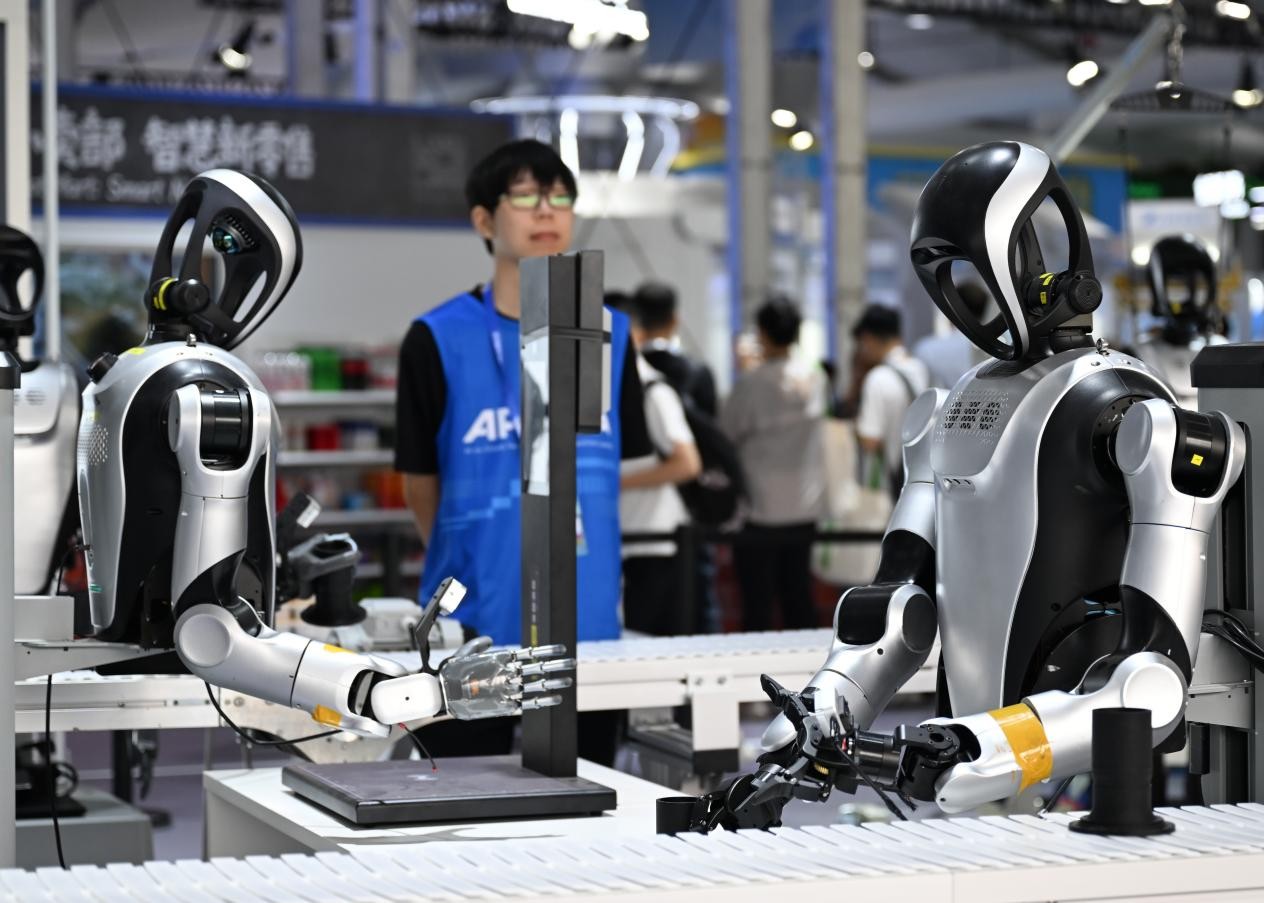
On 29 December, Hangzhou’s municipal legislature approved new regulations to promote the development of embodied intelligent robotics, the first city-level law in China targeting this emerging sector. Pending provincial approval, the regulation would make Hangzhou the first city in China to adopt rules specifically for the embodied intelligent robotics industry.
In 2025, Hangzhou’s AI sector rose to national attention with the so-called “Hangzhou Six Little Dragons,” a group of leading local AI companies, and ended the year with new city regulations promoting the industry. From this early success to the approval of the regulations at year-end, Hangzhou’s AI sector followed a clear path: initial market recognition followed by formal government support. Amid growing competition among Chinese cities to lead in artificial intelligence, Hangzhou has made three significant changes in the way its AI industry is structured, backed by policy, and prepared for long-term growth.
A shift in the industrial landscape
The domestically developed Chinese large language model DeepSeek attracted global attention in 2025, while the “Hangzhou Six Little Dragons” were highlighted among China’s top ten buzzwords of the year by national media. Throughout 2025, the group appeared frequently in AI industry rankings and media coverage.
What began as a group of fast-rising AI and robotics firms attracting attention within the sector has since evolved into a cluster that continues to release new technologies and products, setting benchmarks from robotics to spatial computing. By year-end, several of these companies—including Manycore Tech, Unitree Robotics and DEEP Robotics—had entered IPO preparation processes, highlighting their shift from start-ups to established market players.
This evolution reflects broader changes in Hangzhou’s AI industry. At the company level, more firms are gaining visibility across China. Rokid, RoboCT Technology and Zero Zero Robotics have strengthened their leading positions in specialised areas such as augmented reality, intelligent medical devices and consumer drones. At the city-wide level, Hangzhou’s core AI industry recorded a 26.3 per cent year-on-year increase in revenue and a 22.4 per cent rise in total industrial output between January and October.
The integration of AI into traditional industries has accelerated. Silk manufacturer WENSLI has incorporated AI-generated content (AIGC) technologies into its production process, enabling large-scale personalised silk scarf design. According to the company, its AI model can theoretically generate up to 100,000 unique designs for each of the world’s eight billion people. At Zhongce Rubber’s smart factory, large AI models are used across tyre research, design and manufacturing, cutting product development cycles by 50 per cent and increasing production efficiency by a similar margin.

At the 2025 Yunqi Conference in Hangzhou, Zhejiang, two industrial robots demonstrated an assembly line production scenario. Photo by Wang Gang.
Advances in the innovation ecosystem
Hangzhou has long been known for its innovative spirit, and in 2025 the city took further steps to support AI innovation by expanding policy measures and building technical infrastructure.
At the policy level, Hangzhou’s city government released the Implementation Plan for Accelerating the Development of an AI Innovation Hub (2025 Edition), outlining 20 measures to support the entire AI ecosystem—from research and computing resources to data access and turning innovations into market-ready products. As part of the city’s advanced manufacturing strategy, AI has been chosen as one of two industries targeted to grow into trillion-yuan-scale clusters, showing just how important the sector is for Hangzhou’s long-term industrial plans.
The testing and evaluation infrastructure has also been improved. The Zhejiang Testing Centre of the National Robot Inspection and Assessment Centre officially opened in Hangzhou, hosting four specialised platforms that are the first of their kind nationwide. These include dedicated auditory and visual testing platforms for humanoid robots, a 10-metre EMC (electromagnetic compatibility) anechoic chamber, and a platform for assessing robots’ long-term reliability (MTBF).
The city has continued to build AI support structures. Hangzhou now hosts six national-level public service platforms for next-generation AI, including open innovation platforms for AI computing. The National AI Application Pilot Base (Healthcare) • Zhejiang Industrial Park has been established in Xiaoshan District. So far, the city has identified and published over 300 AI application scenarios, along with the capabilities required for each, aiming to connect technological solutions with real-world needs.
At the local level, district governments have launched AI-focused industrial parks and innovation communities, providing subsidised office space, access to computing resources, funding support, and assistance with regulatory procedures. One such space, “Module-Field Space” in Yuhang District, attracted AI entrepreneur Lan Yaodong, who moved there with only a laptop. Beyond providing workspace, the park connects start-ups to open-source ecosystems and offers high-performance computing and low-code development tools. “It’s easy to find technical collaborators here and even connect with upstream and downstream partners,” Lan said. “Being part of this community really helps early-stage companies keep moving forward.”
Refocusing development objectives
As industrial activity has intensified and support structures have expanded, Hangzhou’s AI ambitions have become more explicit.
Following the surge in attention around the “Hangzhou Six Little Dragons” early in the year, the city’s annual policy-setting meeting highlighted technological innovation, advanced manufacturing, and productivity-enhancing technologies as core priorities for 2025.
In June, Hangzhou held a citywide meeting to mobilise resources for building an AI innovation hub, formally setting this as a medium to long term goal. In mid-December, the city included making Hangzhou China’s leading city for AI innovation and development among its key economic and social objectives for the 15th Five-Year Plan period (China’s fifteenth cycle of five-year development planning, 2026–2030). This builds on Hangzhou’s earlier positioning as a leading centre for the digital economy.
Lan Jianping, Vice President of the Zhejiang Development and Planning Institute, said Hangzhou’s goal of becoming China’s leading city for AI innovation reflects the city’s commitment to the sector. He highlighted key priorities for the coming years, including cultivating benchmark companies, strengthening coordination between chip development and AI model innovation, attracting high-level research teams, and improving the overall innovation environment.
As 2025 draws to a close, Hangzhou continues to roll out initiatives demonstrating sustained investment in AI. These include new policy measures supporting brain-inspired intelligence as a future industry and the launch of Zhejiang’s first “robot school.”
Looking ahead to the start of the 15th Five-Year Plan period (2026–2030 cycle), Liu Fei, Party Secretary of Hangzhou, said the city aims to maintain its lead in foundational AI models, build on its early advantages in the digital economy, and develop high-quality datasets. Hangzhou will prioritise open-source ecosystems, embodied intelligence, and regulatory innovation, while expanding AI applications across industries. The objective is to foster globally competitive AI models and open-source communities, using AI to drive productivity growth and strengthen Hangzhou’s role as Zhejiang’s main engine for innovation-driven development.
(By Bao Mengni)